
Veo 4 / Gemini Omni Leak: Multi-Camera AI Video, Native BGM, 9-Second Clips Ahead of Google I/O
Heads-up: this is a pre-I/O leak commentary. Source attribution at the bottom. Everything below is unconfirmed until Google\'s keynote.
The 30-second version
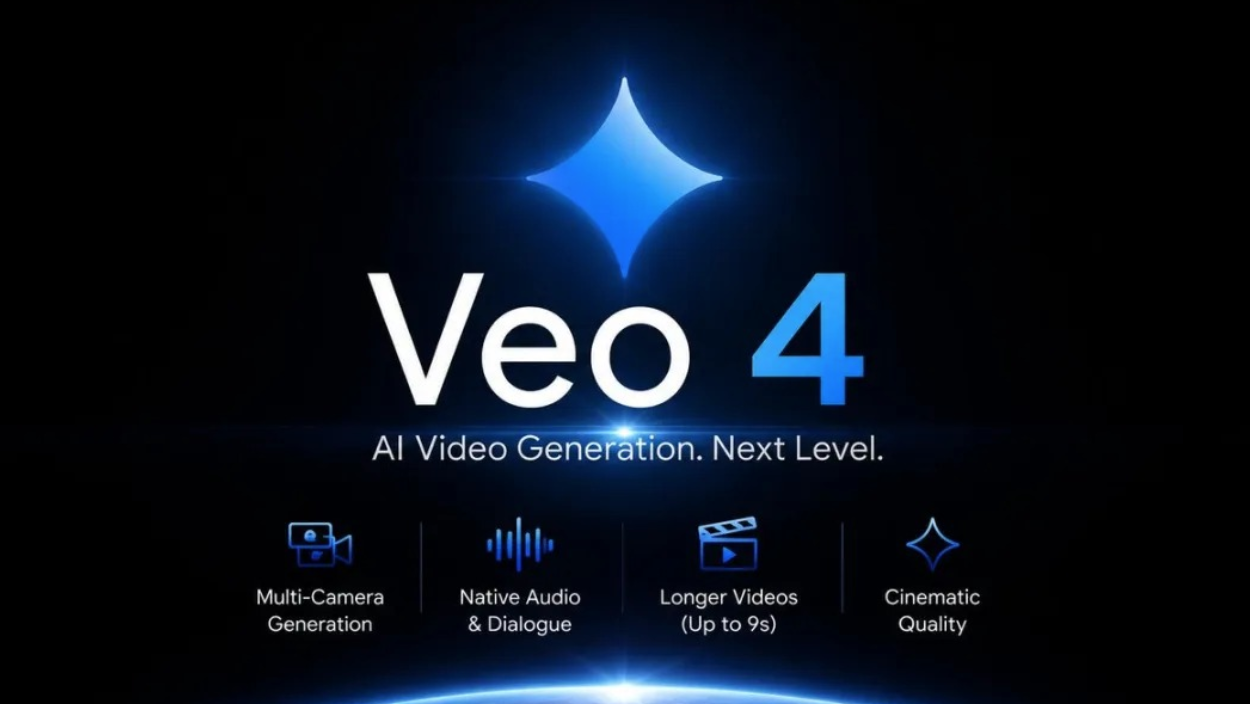
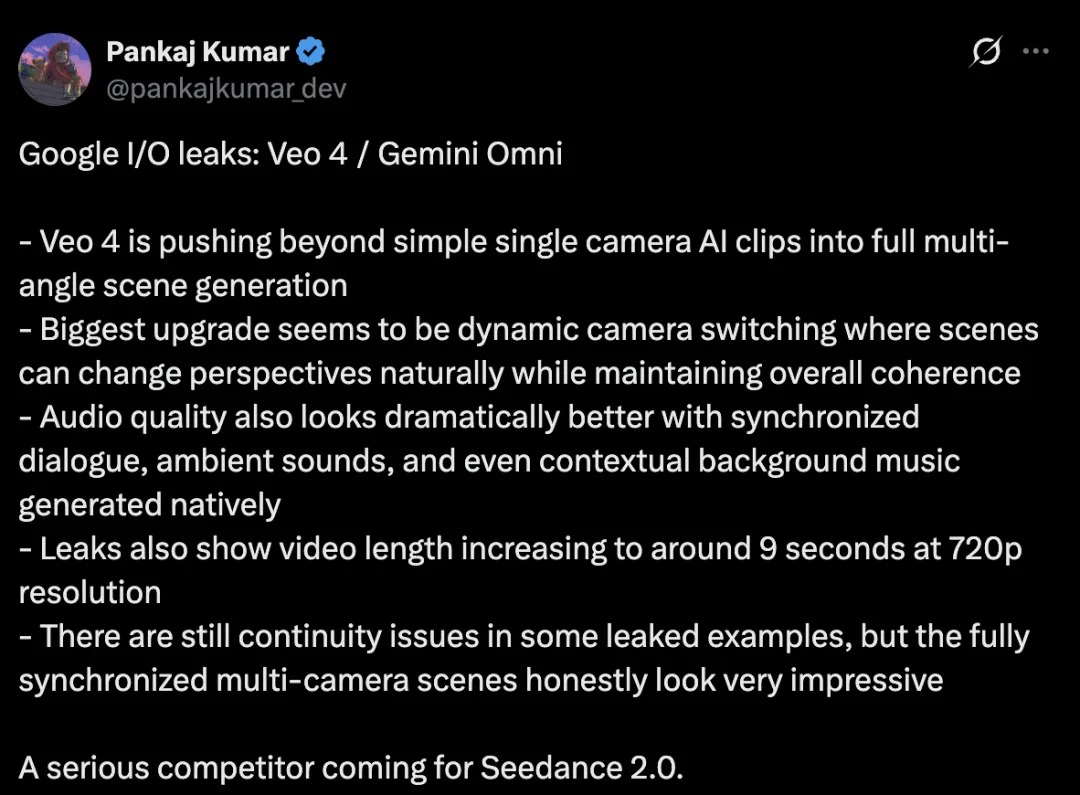
An X post from Pankaj Kumar (@pankajkumar_dev) ahead of Google I/O claims Google is about to ship a video model — branded by the leaker as "Veo 4" — that does three things no general-purpose AI video model has done well before:
- Multi-camera scene generation. Dynamic camera switching within a single render, with the same characters, wardrobe, and props holding across cuts.
- Native audio that finally includes context-aware BGM. Not just footsteps and dialogue — actual situational music generated together with the visuals.
- 9-second clips at 720p. A modest length bump, but with the new structural features it counts differently.
If even half of this lands at I/O, the bar for AI video moves meaningfully in 2026.
Why "multi-camera" is the actual headline
Almost every viral AI video clip you\'ve seen in the last 18 months — Sora demos, Runway Gen-4 showcases, our own Veo 3.1 samples — is structurally one continuous shot. The camera might dolly, push in, orbit. But it doesn\'t cut.
Cuts are hard because a cut means re-generating the same scene from a different angle at the same instant, with:
- The same wardrobe colors and patterns.
- Props in the same positions.
- Lighting state consistent across angles.
- Character identity locked.
- The implied 3D space respected from every camera position.
That is physical, spatial, and temporal consistency layered on top of each other. The industry has been grinding on it for a year. If a single model handles all three end-to-end, that is the difference between AI as a shot generator and AI as a scene generator.
In film terms: the model graduates from cinematographer ("compose this frame") to director ("block this scene"). Multi-cam is how stories are actually told.
Native BGM is the other quiet upgrade
Veo 3 already ships native audio: footsteps, ambient SFX, dialogue lip-synced in one render. That is a 2025 baseline now and one of the reasons we recommend Veo 3.1 for native-audio workflows.
What Veo 3 doesn\'t do well is contextual background music — situational scoring that matches the scene\'s emotional beat. The leak explicitly mentions "contextual background music generated natively." If that ships, you cut Suno or Epidemic Sound out of the workflow entirely for short-form pieces.
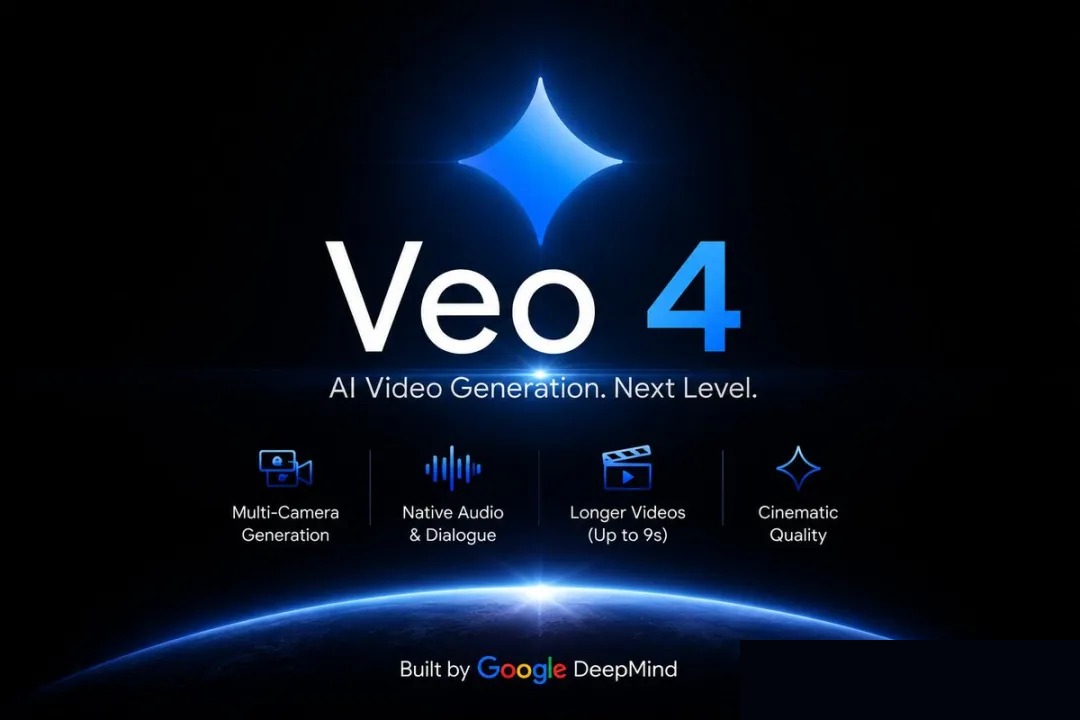
Stack that with multi-camera and the picture becomes clearer: Google isn\'t competing on "prettier frames" anymore. It\'s competing on "who ships the closest thing to a finished cut from one prompt."
The 9-second cap and the compute story
The leak pegs duration around 9 seconds at 720p. In a follow-up reply, Kumar speculated that Google could "easily make it 15s, but the issue is compute" — and explicitly contrasted with ByteDance\'s Seedance, calling Seedance-style models more efficient.
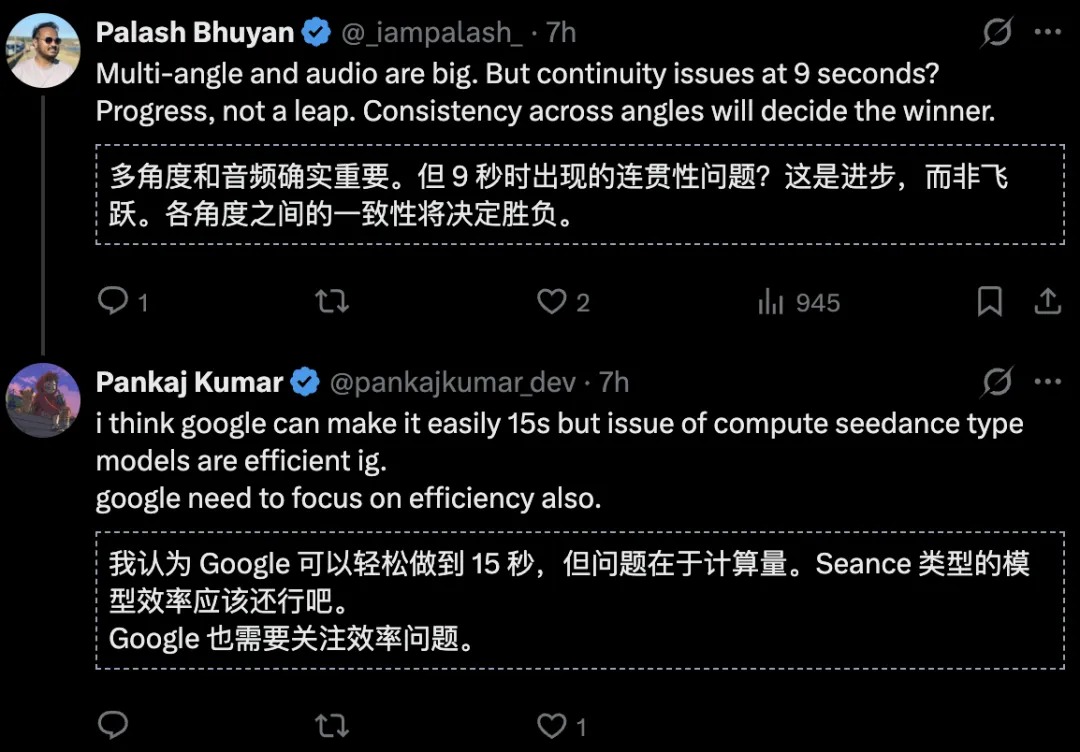
That tracks with what we see in our own pipeline. Seedance 2.0 hits ~85% of flagship quality at a fraction of the per-second cost because its architecture is built for efficiency from the start. Google\'s flagship models tend to start expensive and optimize down later. A 9-second cap is less about model capability and more about what they can serve to millions of users on Day 1 at I/O.
Skeptical takes — is "Veo 4" even the right name?
Not everyone in the leak thread is bullish. The most-shared counter-take, from Bedros Pamboukian (@bedros_p), argues this isn\'t Veo 4 at all:
"Gemini Omni isn\'t / shouldn\'t be Veo 4, the same way Nano Banana isn\'t Imagen. Omni = multimodal. The highlight is that it\'s generating videos with the Gemini model… \'Veo 4\' is clickbait."
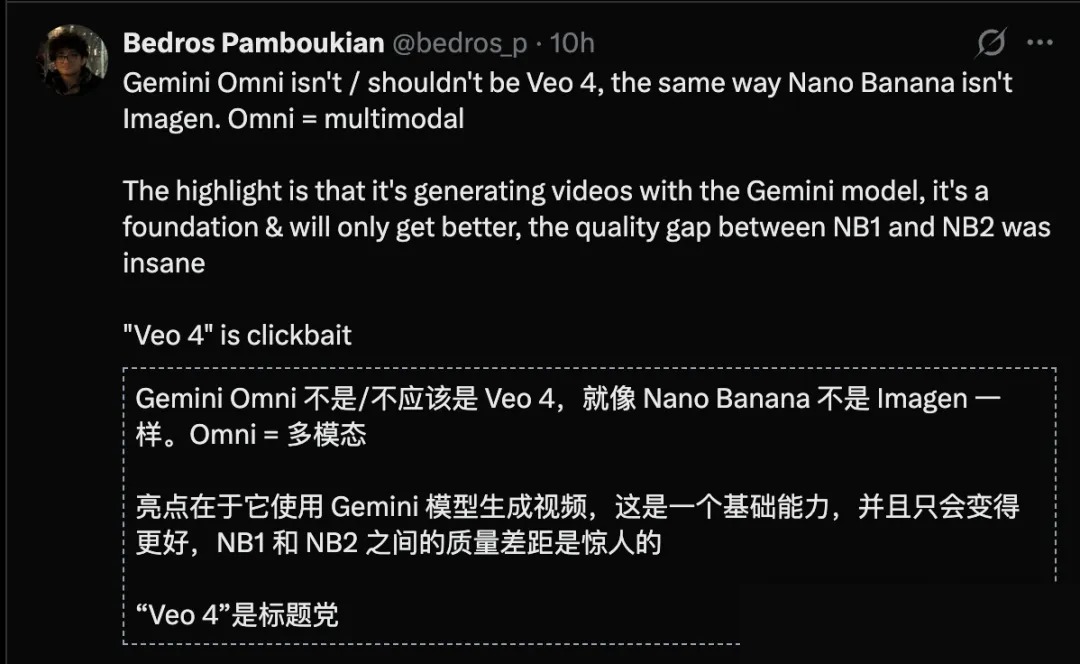
This is actually the more interesting framing. If these capabilities are coming from Gemini Omni — a multimodal foundation model — rather than a discrete Veo 4 release, the implication is that Google is folding video generation into its core Gemini stack instead of treating it as a separate product line.
That mirrors what we saw with Nano Banana for images: Google quietly built best-in-class image editing inside Gemini chat rather than shipping a standalone "Imagen 5" product. If video is going down the same path, that is genuinely a bigger architectural signal than a numbered Veo release.
Why Google is leaking now
The timing is too clean to be accidental. OpenAI\'s Sora consumer app shut down on April 26, 2026. Reports cited unsustainable inference cost (estimates ran into seven figures per day), a sub-8% 30-day retention rate, and total in-app revenue that couldn\'t cover a single day of compute. The Sora API is sunsetting fully on September 24.
Google leaking — or, more likely, letting leaks happen — into that vacuum is a positioning move. The story Google wants the I/O audience to walk in already half-believing is: "The consumer AI video category has a new default, and it\'s Gemini."
What else might land at I/O
The same leak wave reportedly surfaced multiple unreleased Gemini models accidentally pushed to production API endpoints:
- Gemini 3 Flash
- Gemini 3.1 series — Pro, Flash Image, Lite, TTS
- Lyria 3 Pro — high-fidelity audio generation (this is the model most likely powering the "native BGM" claim)
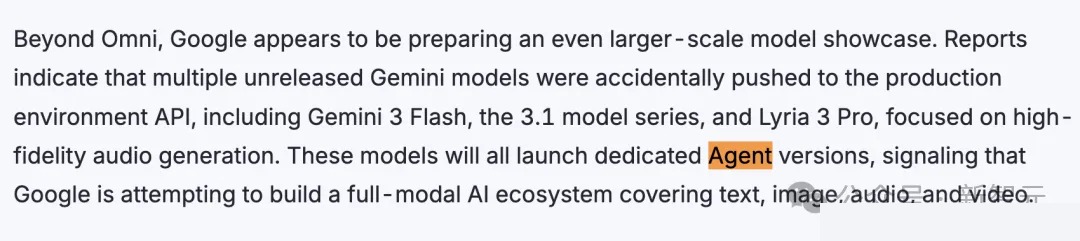
The phrase that matters most in the leaks: "Omni models will launch dedicated Agent versions across all core models."
Translation: video generation, audio generation, image editing, and agent frameworks all get unified at I/O. A year ago Sundar Pichai said Gemini would live inside every Google product. This is the keynote where that line gets visual proof.
What this changes for AI video creators in 2026
If multi-camera + native BGM lands, three things shift for creators using AI video tools:
- One-prompt scenes replace one-prompt shots. The unit of generation moves from "clip" to "beat." You prompt the moment, not the frame.
- The post-production stack thins out. No more Suno → ElevenLabs → CapCut to assemble a 9-second deliverable. The model ships it ready.
- Stylized models stay safe. Photoreal multi-cam is what\'s leaking. Kling 3.0 for anime and Wan 2.7 for open-weight workflows aren\'t in the same lane — they\'ll keep their share.
What to watch on I/O day
- Is it called Veo 4 or shipped under the Gemini Omni umbrella?
- Live multi-cam demo with audience-suggested prompts, or pre-baked reels?
- Stated cost per second vs Veo 3.1 (~$0.75/s today).
- API availability — same day, or "rolling out over the coming weeks"?
- Whether Lyria 3 Pro ships as a standalone audio API.
FAQ
Is "Veo 4" confirmed?
No. As of writing, the only public source is a single X thread from Pankaj Kumar. Treat all specifics as unconfirmed until Google\'s I/O keynote.
Will it be available on forvideo.ai?
If it ships with public API access — yes, we plan to integrate alongside Veo 3.1 the same way we did for previous Google video models.
What should I use today?
For native-audio cinematic video, Veo 3.1 remains the best-shipping option. For stylized work, Kling 3.0. For cost-efficient volume, Wan 2.7 or Hailuo 02.